


Screen Printing Mesh Count Guide: How To Choose The Right Polyester Mesh Between 43T And 200T For Your Print Job
[TL;DR] Choosing the wrong polyester screen printing mesh count is one of the most common causes of scrapped print runs. This guide compares KAIBANG's monofilament polyester printing mesh across a 13T–180T (33–460 mesh) range, white vs. yellow color, and plain vs. twill weave, so procurement buyers can match mesh specification to substrate - from CD/DVD and glass to solar panel and textile printing - before requesting samples.
Sourcing screen printing mesh sounds simple until the wrong count reaches your production line. A mesh that is too fine starves heavy ink deposits on ceramics or glass; a mesh that is too coarse blurs fine circuit lines on electronic printing. Because polyester monofilament mesh is sold under dozens of near-identical spec sheets, procurement teams often end up comparing marketing claims instead of comparable data - count, aperture, thread diameter, and weave type. This guide breaks down how mesh count, color, and weave structure actually affect print outcome, using verified specifications from KAIBANG's polyester screen printing mesh line, so you can shortlist a spec before requesting swatches.
Why Mesh Count and Structure Decide Your Print Outcome
Mesh count sets your ink deposit ceiling
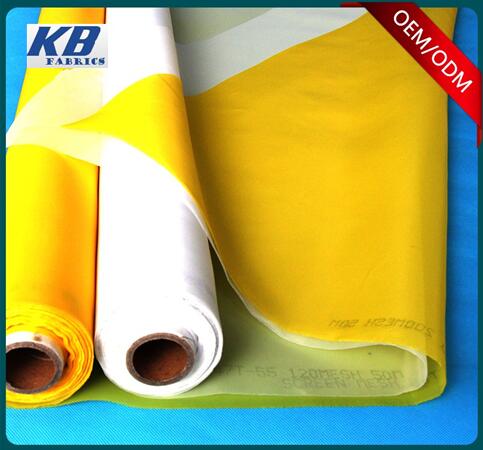
Mesh count - the number of threads per inch in warp and weft - is the single variable that most affects how much ink passes through the screen. KAIBANG's monofilament polyester mesh spans 13T to 180T (33 mesh to 460 mesh), with mesh opening from 23 to 619 microns and thread diameter from 31 to 150 microns. Lower counts (coarser mesh, larger openings) push through more ink for opaque coverage; higher counts hold finer detail but limit deposit thickness.
Opening rate governs precision and coverage together
Opening rate (13%–64% across the range) and thickness (43–300 microns) determine how the mesh balances precision against volume. A higher opening rate lets more ink through per pass - useful for solar cell busbar printing or ceramic glaze - while a tighter, lower-opening structure holds crisp edges for graphics, packaging, and electronic circuit printing. Matching this to your substrate before ordering avoids re-tensioning screens mid-run.

Yellow vs. White Mesh, Plain vs. Twill Weave: Which Fits Your Application?
Buyers frequently default to whichever color or weave a supplier has in stock. Click a tab below - color affects photoimaging accuracy, weave affects tensile strength and ink release.
| Comparison Point | Yellow Monofilament Mesh | White Monofilament Mesh |
| Typical mesh count | Usually 200+ threads/inch | Available across the full 13T–180T range |
| Best suited for | Fine-detail photoimaging (electronics, graphics, glass) | General-purpose and heavier-deposit printing (packaging, ceramics, textiles) |
| Why it matters | Yellow fiber reduces internal light scatter during UV stencil exposure, sharpening fine lines | Easier visual ink-flow inspection on the press floor |
| Comparison Point | Plain Weave Mesh | Twill Weave Mesh |
| Structure | Each warp thread passes over/under one weft thread | Threads pass over two or more, creating a diagonal pattern |
| Strength profile | More stable, more precise mesh opening | Higher tensile strength for coarser, heavy-count mesh |
| Recommended for | Standard graphics, CD/DVD, packaging printing | Low-count mesh needing extra durability under tension |
5-Step Checklist for Selecting Your Screen Printing Mesh Count
Why Buyers Source Polyester Printing Mesh from KAIBANG
0
Founded in Cangzhou, Hebei, China
~0
Employees, over 20% are engineers
0+
Years producing polyester printing mesh
Cangzhou Kaibang Industry & Trade Co., Ltd (KAIBANG) has produced and exported paper machine clothing, screen printing mesh, and filter belts since 2012. Weaving looms from Germany, heat-setting machines from Germany and Norway, and automatic seaming equipment from Austria run in temperature- and humidity-controlled, dust-free workshops, backed by an in-house R&D team. See the full production and quality profile on the About Us page.
Frequently Asked Questions
Matching mesh count, color, and weave to your exact substrate before ordering is what separates a clean, repeatable print run from a batch of wasted screens. If you're unsure which specification fits your job, KAIBANG's technical team can review your artwork and ink requirements and recommend a spec sheet before you commit to a roll order.
Need help selecting the right mesh count for your job?
Send your substrate, ink type, and target print detail - KAIBANG's team will recommend a mesh count, color, and weave spec and quote from stock.
Request a Quote Contact Us


